

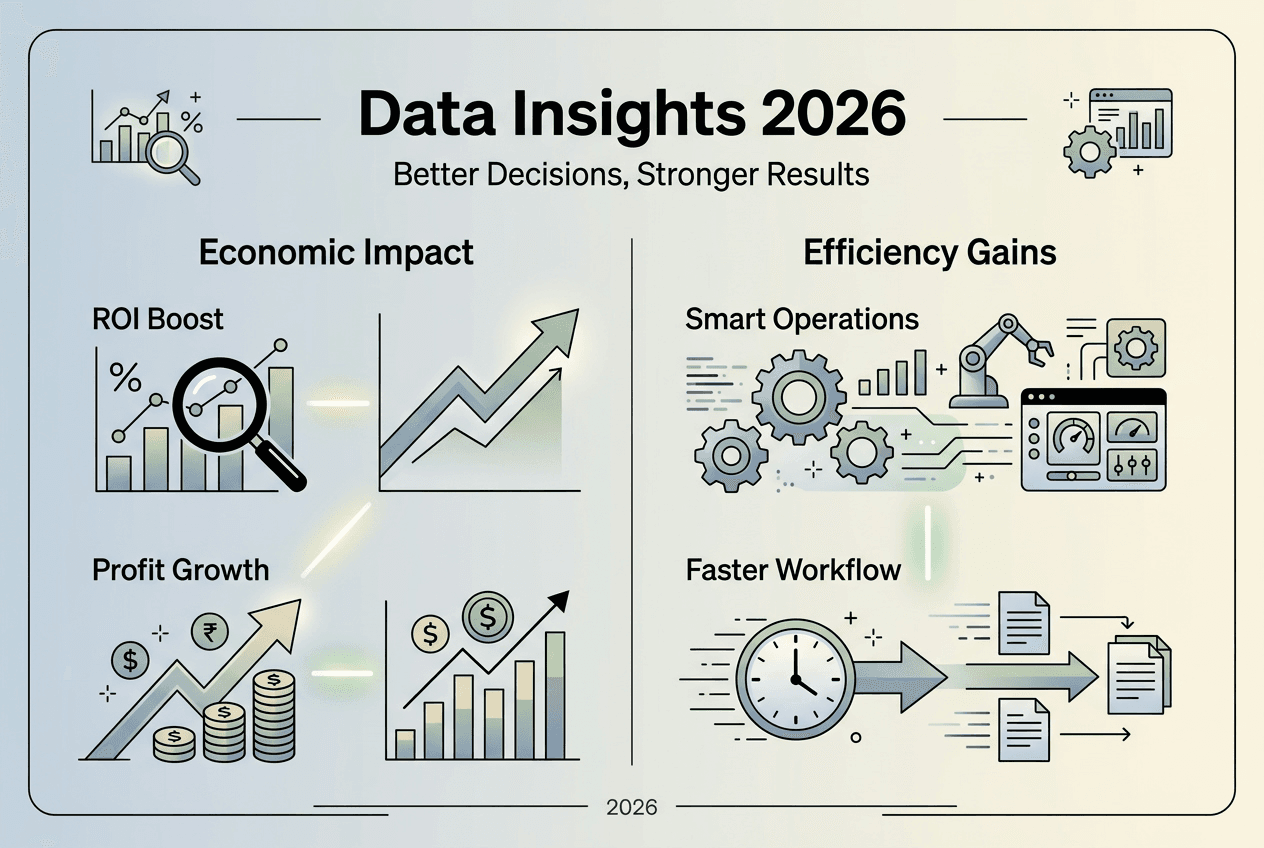
Most executives still make critical decisions based on experience and advice rather than hard evidence. While intuition has its place, 62 percent of executives rely on experience over data, leaving money and opportunity on the table. Data insights transform this approach by providing evidence-based direction that improves profitability, accelerates decision speed, and sharpens competitive advantage. This guide explains how leveraging data insights elevates business outcomes and operational efficiency for enterprises in 2026.
Table of Contents
- The Strategic Value Of Data Insights In Modern Enterprises
- Implementing Data Architectures: Organizing Data For Actionable Insights
- Driving Operational Efficiency And Decision Quality With Predictive Analytics
- Overcoming Challenges And Fostering A Data-Driven Culture
- Partner With VIS Innovations For Your Data-Driven Transformation
- Frequently Asked Questions
Key takeaways
| Point | Details |
|---|---|
| Profitability impact | Nearly half of executives report improved profitability from digital transformation with data over the past two years |
| ROI potential | AI and analytics deployments can deliver 354% return on investment over three years when properly implemented |
| Operational gains | Predictive analytics reduces equipment downtime by 25 to 35 percent while improving customer retention |
| Cultural shift | Organizations highly focused on data-driven approaches are three times more likely to see significant decision-making improvements |
| Architecture matters | Structured data handling through lakehouse and Medallion Architecture ensures reliable, high-quality insights for strategic choices |
The strategic value of data insights in modern enterprises
Data insights deliver measurable economic returns that transform business performance. Nearly half of U.S. executives surveyed say digital transformation with data improved profitability or performance over the last two years. This shift from gut feelings to evidence-based strategy creates competitive separation in crowded markets.
The financial case grows stronger with quantified returns. Snowflake's TEI study estimated 354% ROI over three years for AI deployments. These numbers reflect real productivity gains, faster time to market, and reduced operational waste. Companies investing in data analytics & business intelligence capabilities position themselves to capture similar returns.
Decision speed matters as much as decision quality. Data insights compress the time between identifying problems and implementing solutions. Executives armed with real-time dashboards and predictive models respond to market shifts before competitors recognize the pattern. This velocity advantage compounds over quarters and years.
Relying solely on experience creates blind spots. Personal history cannot account for emerging trends, shifting customer preferences, or new competitive threats. Data fills these gaps by revealing patterns invisible to individual observation. The combination of seasoned judgment and analytical rigor produces superior outcomes.
"Data-driven organizations make faster, more accurate decisions that directly impact bottom-line results and market position."
Key business benefits from data insights include:
- Enhanced forecasting accuracy for revenue, demand, and resource allocation
- Risk identification before issues escalate into costly problems
- Customer behavior understanding that drives retention and lifetime value
- Operational bottleneck detection enabling targeted process improvements
- Market opportunity recognition through trend analysis and competitive intelligence
These advantages accumulate. Each better decision creates momentum for the next. Organizations that embed data insights into daily operations build institutional knowledge that becomes harder for competitors to replicate. The strategic value extends beyond individual projects to reshape entire business models.
Implementing data architectures: organizing data for actionable insights
Data architecture defines how information flows from collection through transformation to consumption. Data architecture determines how analytics and machine learning systems access the fuel they need. Without proper structure, even sophisticated algorithms produce unreliable results.

Traditional approaches split between data warehouses and data lakes. Warehouses offer structured storage optimized for business intelligence but struggle with unstructured data and scale costs. Lakes handle massive volumes and diverse formats but lack the governance and performance needed for critical reporting. This divide forced uncomfortable tradeoffs.
Lakehouse architecture combines benefits of both approaches for scalable, reliable analytics. The lakehouse model stores raw data economically while enabling structured queries and strong governance. This unified platform eliminates data movement between systems, reducing complexity and latency. Enterprises gain flexibility without sacrificing control.
Medallion Architecture takes organization further by creating quality layers. Medallion Architecture organizes data into Bronze, Silver, and Gold layers, improving quality progressively. Each layer serves specific purposes and user groups. This staged approach ensures data consumers access information appropriate for their needs.
| Layer | Purpose | Characteristics |
|---|---|---|
| Bronze | Raw ingestion | Unprocessed data from sources, complete history, minimal transformation |
| Silver | Cleaned and validated | Deduplicated, standardized formats, business rules applied |
| Gold | Business-ready | Aggregated metrics, optimized for reporting, aligned to business logic |
This layered strategy enhances insight reliability by establishing clear quality gates. Data scientists work with Silver layer information for exploration while executives consume Gold layer dashboards confident in accuracy. The separation prevents raw data issues from contaminating business reports.
Architecture choices directly impact decision quality. Poor structure leads to conflicting reports, slow query performance, and analyst frustration. Proper design through data analytics & business intelligence frameworks and Power BI services enables self-service analytics where business users find answers without IT bottlenecks.
Pro Tip: Start with a lakehouse foundation if your organization handles diverse data types and anticipates growth. The flexibility pays dividends as analytics needs evolve and new data sources emerge.
Driving operational efficiency and decision quality with predictive analytics
Predictive analytics applies statistical models and machine learning to forecast future outcomes based on historical patterns. This capability transforms reactive operations into proactive strategies. Maintenance teams predict equipment failures before breakdowns occur. Marketing departments identify at-risk customers before they churn. Supply chains anticipate demand spikes before inventory runs short.
The implementation process follows clear steps:
- Define the business problem and success metrics you want to improve
- Identify relevant data sources including historical records and external signals
- Clean and prepare data ensuring quality and completeness across time periods
- Select appropriate algorithms based on problem type and data characteristics
- Train models using historical data and validate accuracy against holdout sets
- Deploy models into production systems with monitoring and alerting
- Continuously refine based on new data and changing business conditions
This systematic approach ensures models deliver practical value rather than academic exercises. Each step requires collaboration between business stakeholders who understand context and technical teams who build solutions.
Operational benefits from predictive data insights include:
- Reduced equipment downtime through early failure detection
- Lower inventory costs by matching stock levels to predicted demand
- Improved customer retention via churn risk scoring and intervention
- Optimized staffing based on forecasted workload patterns
- Enhanced quality control through defect prediction and prevention
Real-world impact validates the investment. Companies using advanced analytics for predictive maintenance reduce downtime by 25 to 35 percent. This translates directly to higher production output and lower emergency repair costs. Manufacturing, logistics, and energy sectors see particularly strong returns.
Customer-facing applications deliver measurable improvements too. A food services organization reduced customer churn by 4.5 percent using AI-driven supply chain optimization. By ensuring product availability and freshness through better demand forecasting, they strengthened customer satisfaction and loyalty. These gains compound as retained customers generate repeat revenue.
Predictive analytics accelerates decision quality by providing forward-looking visibility. Leaders shift from asking "What happened?" to "What will happen?" and "How should we respond?" This proactive stance creates competitive advantage as organizations shape outcomes rather than react to events. Power Platform solutions and Power Apps services enable rapid deployment of predictive models into business workflows where they drive daily decisions.
The responsiveness advantage matters most in fast-moving markets. Companies that detect and act on signals first capture opportunities competitors miss. Predictive insights compress the observe-orient-decide-act cycle, enabling agile responses to threats and opportunities alike.
Overcoming challenges and fostering a data-driven culture
Cultural resistance poses the biggest barrier to data adoption. 62 percent of executives still rely on experience over data-driven decisions despite proven benefits. This preference stems from comfort with familiar approaches and skepticism toward analytical methods. Changing mindsets requires patience, proof, and executive sponsorship.
Data governance gaps undermine confidence in insights. Without clear ownership, quality standards, and access controls, users question whether information is trustworthy. Conflicting reports from different systems breed cynicism. Strong governance establishes single sources of truth that everyone can rely on for critical decisions.
"Data governance is crucial for reliable insights and decisions." – Dr. Michael Stonebraker
The cultural transformation requires deliberate action. Organizations successfully shifting to data-driven operations take these steps:
- Secure visible executive sponsorship that models data-based decision making
- Start with quick wins that demonstrate value and build momentum
- Invest in training programs that build analytical literacy across roles
- Establish clear data ownership and stewardship responsibilities
- Create feedback loops where users share insights and improve systems
- Celebrate successes publicly to reinforce desired behaviors
- Provide accessible tools that make data exploration easy for non-technical users
These initiatives work together to normalize data use. As more people experience better outcomes from analytical approaches, adoption accelerates naturally. Highly data-driven organizations are three times more likely to report significant improvements in decision-making. This performance gap motivates laggards to catch up.
Data quality management requires ongoing attention. Poor quality data produces misleading insights that erode trust. Establishing validation rules, monitoring data pipelines, and addressing issues promptly maintains confidence. Adoption & change management programs help teams navigate the transition from intuition-based to evidence-based operations.
Pro Tip: Avoid the perfectionism trap in data quality. Focus first on making critical business data reliable rather than trying to fix everything at once. Prioritize based on decision impact and user needs.
Partner with VIS Innovations for your data-driven transformation
Transforming into a data-driven enterprise requires expertise across technology, process, and people dimensions. VIS Innovations brings comprehensive capabilities in data analytics & business intelligence, Power BI services, and adoption & change management to accelerate your journey. We help mid-sized and large enterprises build the data foundations, analytical capabilities, and cultural practices needed for sustained competitive advantage.
Our integrated approach addresses technical architecture, visualization platforms, and organizational readiness simultaneously. We design lakehouse implementations tailored to your data landscape, deploy Power BI solutions that deliver insights where decisions happen, and guide change management that embeds data thinking into daily operations. This holistic support ensures your investment delivers the profitability improvements and operational gains that leading organizations already enjoy.
Frequently asked questions
What are the main benefits of using data insights in business?
Data insights improve decision accuracy, speed, and consistency across the organization. They reveal patterns and opportunities invisible to individual observation while reducing reliance on gut feelings. Financially, companies report higher profitability, better resource allocation, and stronger competitive positioning when leveraging analytical capabilities.
How can data-driven decision-making improve operational efficiency?
Predictive analytics identifies maintenance needs before equipment fails, reducing downtime by 25 to 35 percent in many industries. Supply chain optimization matches inventory to forecasted demand, cutting carrying costs. Customer behavior models enable proactive retention efforts that reduce churn. These applications translate data into tangible cost savings and revenue protection.
What challenges do organizations face when adopting data insights?
Cultural resistance from executives accustomed to experience-based decisions creates the primary obstacle. Data governance gaps lead to quality issues and conflicting reports that undermine confidence. Technical complexity around architecture choices and tool selection can overwhelm teams. Successful adoption requires executive sponsorship, clear governance frameworks, and change management support to address these barriers.
How can companies ensure a positive ROI from AI and analytics investments?
Start by defining clear business objectives and success metrics before selecting technology. Use Total Economic Impact frameworks to quantify expected returns across productivity, cost reduction, and revenue growth. Implement in phases with quick wins that build momentum and justify further investment. Monitor actual outcomes against projections and adjust approaches based on results.
What first steps should executives take to become more data-driven?
Prioritize building solid data infrastructure through lakehouse or similar architectures that support diverse analytics needs. Secure executive sponsorship from leaders willing to model data-based decision-making publicly. Invest in training programs that build analytical literacy across business functions. Consider partnering with experts who can accelerate implementation and avoid common pitfalls.